
Generic Soft

Engineering teams built around your needs — from solo engineers to full-scale squads.

SOFTWARE DEVELOPMENT Custom Software Development Web Application Development Backend Development Frontend Development E-commerce Development MVP Development SaaS Development UX/UI Design AI & MOBILE Machine Learning Deep Learning Computer Vision Natural Language Processing Agentic AI LLM Integration iOS App Development Android App Development Cross-Platform App Development CLOUD, QA & DATA Cloud Migration Cloud Architecture DevOps & CI/CD Cybersecurity Software Testing & QA Automation Testing Business Intelligence Big Data CRM All Services → OUR PRODUCTS
MSGPLS Viber business messaging

Sell more in every chat Support that never sleeps Every delivery in the loop Campaigns people answer

Product offers, cart reminders and checkout — right inside Viber, where your customers already are.

Boost my sales
INSECTARIUM-X TRL 7 Automated Bio-Protection

Precise Microclimate Remote Control Full Traceability Autonomous Operation

Automated management of temperature, humidity, lighting, and ventilation for reliable breeding of beneficial bioagents.

Request a Demo

We've delivered 60+ projects across 11+ sectors. Experience in your industry? We have it.

Agriculture Banking Fintech Insurance Healthcare Real Estate Logistics IoT AI Cybersecurity Blockchain All Industries → Careers Technologies Our Work Blog

AI for business · Practical guide

AI for Business in 2026: Where Companies Actually See Results

Most companies use AI. Few get real value from it. Here are the five places where the value shows up first, and how to pick your first project.

Generic Soft team 9 min read

The short answer

AI for business pays off first where a repeated process meets usable data and one measurable goal: customer support, document and data processing, sales and marketing content, internal knowledge search and software development. In 2026 most companies use AI, but only 37% of respondents in McKinsey’s 2026 survey report any contribution to earnings (EBIT).

Short on time? Jump to how to pick your first AI project.
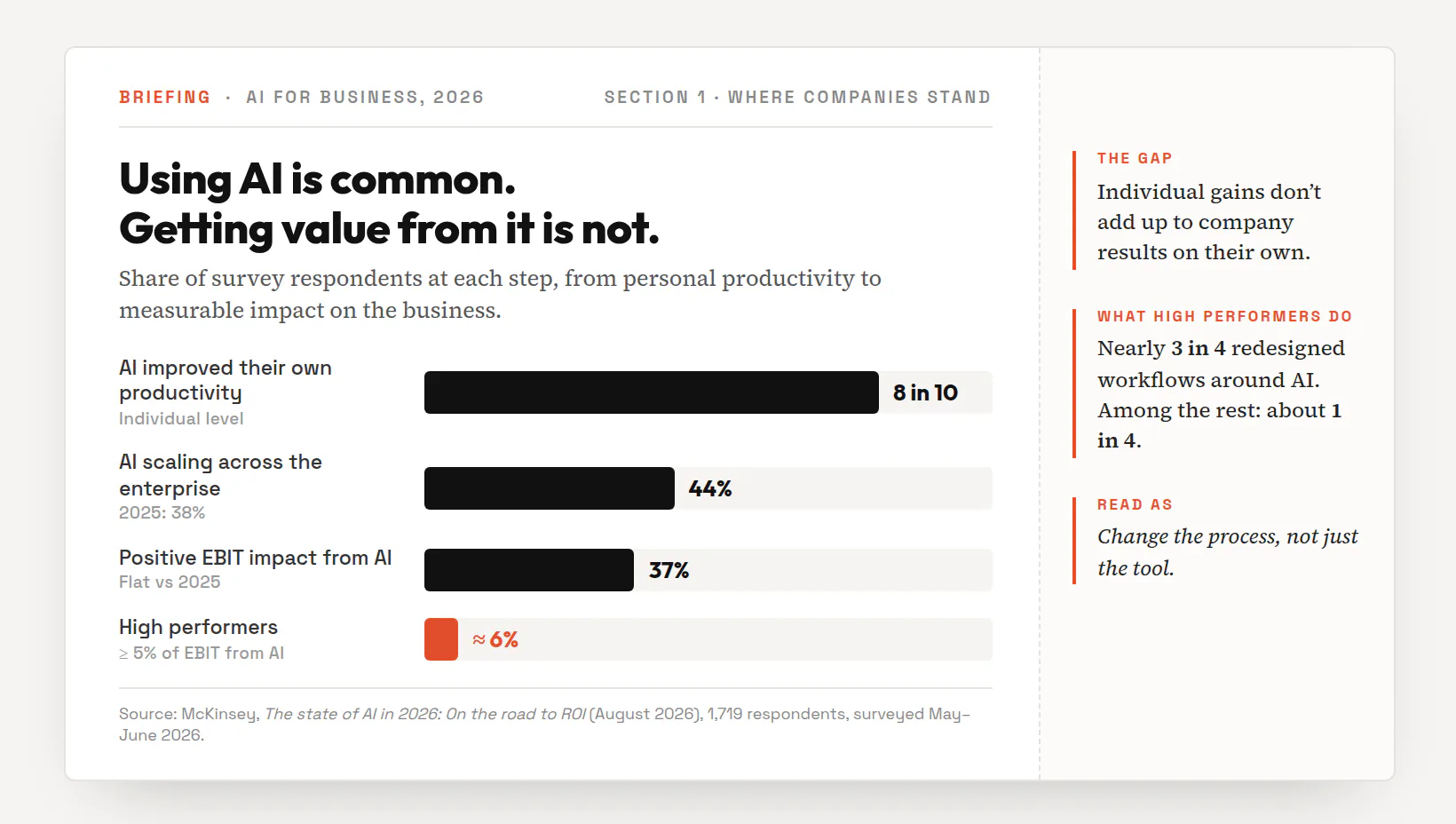
Chart: 8 in 10 say AI improved their productivity, 44% scale AI, 37% see EBIT impact, about 6% are high performers (McKinsey 2026)
From “AI helps me” to “AI helps the business”: each step loses most of the field. Data: McKinsey, The state of AI in 2026.

Ask people at work whether AI makes them faster, and most will say yes. Ask the finance director whether AI shows up in the profit and loss, and the room goes quiet.

That gap is the real story of AI for business in 2026. Eight in ten respondents in McKinsey’s latest global survey say AI has improved their own productivity. Only 37% say it has contributed to their company’s earnings, and that number has barely moved in a year.

The companies that close the gap aren’t using secret models. They pick different problems. This guide shows you which ones.

Where does AI for business stand in 2026?

AI for business means using machine learning and language models to speed up or automate real business processes, measured against a business number. For most organisations it is no longer an experiment. In McKinsey’s The state of AI in 2026: On the road to ROI (1,719 respondents, surveyed May–June 2026, published August 2026):

So adoption keeps rising while results stand still. The same survey hints at why. Nearly three in four high performers say they fundamentally redesigned workflows around AI. Among everyone else, only about one in four did.

In other words, the winners didn’t add a chatbot to the old process. They changed the process. That redesign is the core of our AI transformation work.

5 AI use cases for business that deliver results first

In our own client projects and in the published research, the same five areas keep paying off first. Each has a repeated task, data you already own, and a number you can measure before and after.
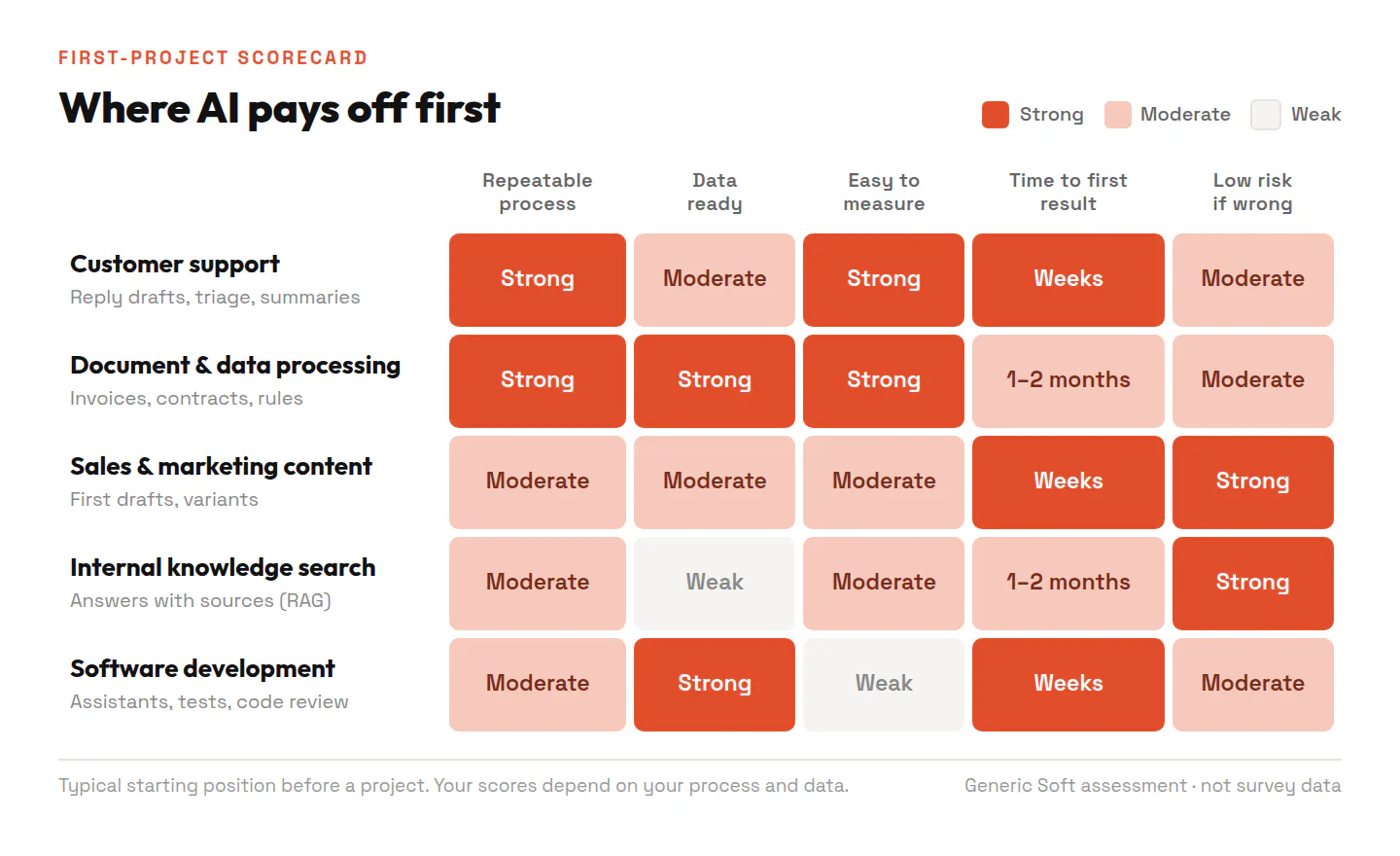
Heatmap scoring five AI use cases for business (customer support, document and data processing, sales and marketing content, internal knowledge search, software development) on repeatable process, data ready, easy to measure, time to first result and risk if wrong
How the five areas typically score before a project starts. Generic Soft assessment, not survey data.

1. Customer support

Support is the best-studied AI use case for business. In a study of 5,179 support agents, an AI assistant raised issues resolved per hour by 14% on average and by 34% for new and less experienced agents (Brynjolfsson, Li and Raymond, “Generative AI at Work”, Quarterly Journal of Economics, 2025).

Start with drafting replies, sorting incoming tickets and summarising long threads. Keep a person on the send button. Measure handling time and first-contact resolution.

2. Document and data processing

Invoices, contracts, delivery notes, regulations: most companies run on documents that someone reads and retypes. Language models are good at turning that unstructured text into structured fields, as long as a person checks what matters.

We built exactly this for a global mobility company: an AI crawler that tracks toll and emission zone rules across government websites and PDFs. The proof of concept covered more than 30 cities and toll assets in four countries with 14 scraper modules. A fingerprint check skips AI analysis for pages that haven’t changed, which cut AI costs by roughly 70–80% on repeat runs. Every change still goes to a person for review.

3. Sales and marketing content

First drafts of product descriptions, proposals, follow-up emails and campaign variants. AI does the blank page; your team does the judgement and the brand voice.

The measurable win is time from brief to published, and the number of variants you can afford to test. Don’t measure “words generated”. It tells you nothing.

4. Internal knowledge search

Every company has answers buried in wikis, policies, tickets and shared drives. A retrieval-augmented assistant (RAG) searches your own documents and answers with links to the source, so people can check it.

It works when the documents are reasonably current and access rights are respected. Measure the time it takes to find an answer and how many questions still end up with the same three experts.

5. Software development

Developers adopted AI faster than anyone. In the Stack Overflow Developer Survey 2025, 84% of respondents use or plan to use AI tools in their work, and 51% of professional developers use them daily.

The same survey shows the catch: more developers distrust the accuracy of AI output (46%) than trust it (33%). The gains are real for boilerplate, tests and code reading. They depend on code review, tests and engineers who understand what they are merging.

What do successful AI projects have in common?

Look at the five areas again and the pattern is plain. The wins don’t come from the most advanced model. They come from three boring conditions:

  1. A clear process. The task happens often, follows recognisable steps and has an obvious “done”. If nobody can describe the process, AI can’t improve it.
  2. Usable data. The inputs exist, you are allowed to use them, and they are good enough that a careful person could do the job with them.
  3. One measurable goal. Minutes per ticket, documents per day, cost per check. Write the baseline down before you start, or you will never prove the result.
The companies that get value from AI don’t have better models. They have a clearer process, cleaner data and one number they care about.

Before we write any code, we put those three conditions on one page together with an owner. If a field stays empty, the project isn’t ready yet.

Want a one-page brief for your first AI project?
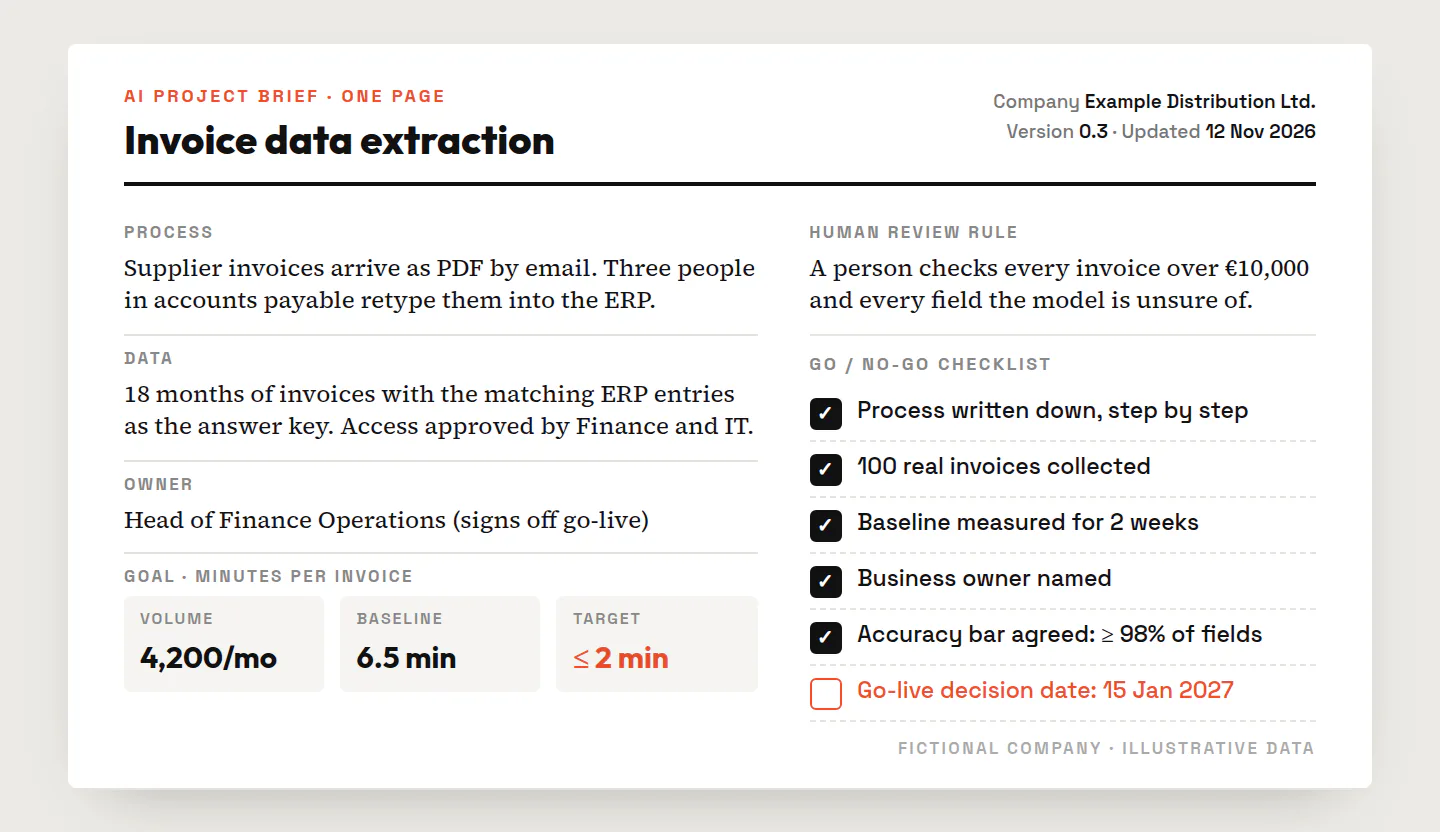
One-page AI project brief for invoice data extraction at a fictional distributor: process, data, owner, baseline and target metric, human review rule and a go/no-go checklist
A one-page brief for a first AI project. Fictional company, illustrative data.

How to use AI in business: quick wins vs long bets

Not every good idea should be your first project. Sort your candidates by two questions: how much value would it create, and how much effort and risk does it take to get there?
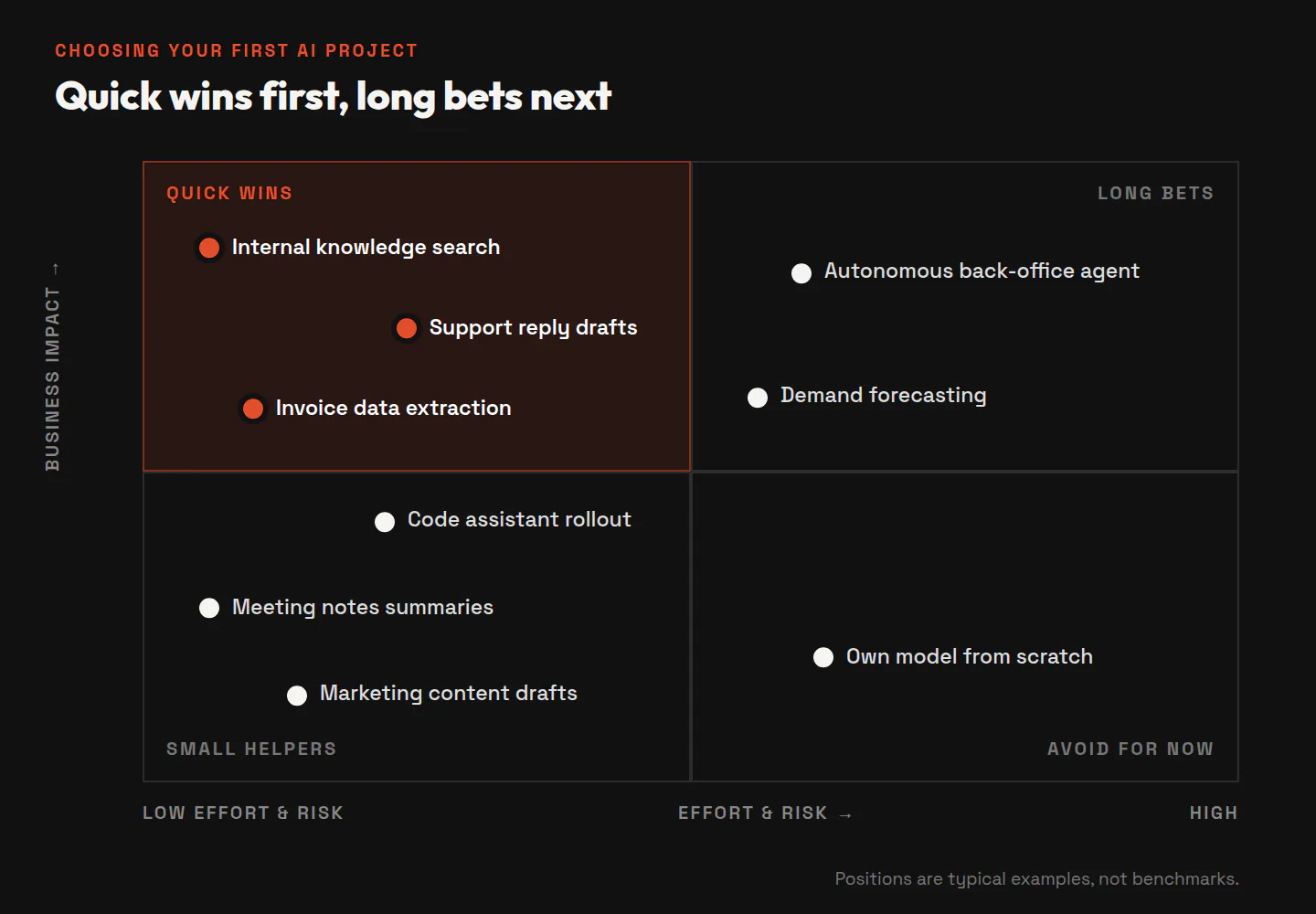
Impact versus effort matrix for AI projects: quick wins such as support reply drafts, invoice data extraction and internal knowledge search; long bets such as demand forecasting and autonomous back-office agents
Typical first-project candidates placed on an impact/effort grid. Positions are examples, not benchmarks.
Quick wins vs long bets
CriterionQuick winLong bet
ExampleDraft support replies, extract invoice dataDemand forecasting, an agent that runs a whole back-office process
DataAlready there, in one systemSpread across systems, needs cleaning
Time to first resultWeeksMonths
Risk if wrongLow: a person reviews every outputHigher: decisions run with less review
What it buys youProof, trust and a team that knows howA lasting advantage, if the basics hold

Pick your first project in four steps:

  1. List the repetitive work. Ask each team which task eats the most hours and follows the same steps every time.
  2. Check the data. For each candidate, can you get 100 real examples this week? If not, it’s not a quick win.
  3. Set the number. Agree on one metric, measure today’s baseline and name the person who owns the result.
  4. Build a small, real pilot. Use real data and real users from day one, with a person reviewing the output, and decide in advance what result means “go live”.

Start with a quick win even if the long bet is more exciting. It gives you proof, a team that has done it once, and the trust to fund the bigger project.

Mistakes to avoid with AI automation for business

Most AI automation projects fail for reasons that have nothing to do with AI. Three show up again and again:

A fourth one is quieter: skipping human review to save time. Keep a person in the loop until the numbers show you where you can safely step back.

How Generic Soft helps: AI transformation from audit to production

Generic Soft (genericsoft.eu) is a software development company based in Sofia, Bulgaria, that builds custom software, AI solutions and dedicated engineering teams. Our AI transformation services take you from idea to a system people use every day:

  1. Audit. We map your processes and data and find where AI can move a number you care about.
  2. Prioritise. Quick wins and long bets on one page, with owners and metrics.
  3. Prove it. A focused proof of concept on your real data, like the AI crawler case study.
  4. Ship it. LLM integration into your existing systems, with evaluation, monitoring, cost control and security built in.

Frequently asked questions

What are the best AI use cases for business in 2026?

The use cases that pay off first are customer support, document and data processing, sales and marketing content, internal knowledge search and software development. They share a repeated process, data the company already owns and a result you can measure, such as minutes per ticket or documents processed per day.

How do I start using AI in my business?

List the repetitive tasks that take the most hours, check that you have real data for each, and pick one with a clear metric and an owner. Measure the baseline, then run a small pilot on real data with a person reviewing the output before you scale it.

Why do so many AI projects fail to deliver value?

Usually not because of the model. Common causes are starting from a tool instead of a problem, no business owner, no baseline metric and leaving the old process unchanged. McKinsey’s 2026 survey found that high performers are far more likely to redesign workflows around AI.

How long does a first AI project take?

A quick win with data already in one system can show first results in weeks. Projects that need data from several systems, new integrations or more autonomy, such as forecasting or AI agents, typically take months.

Do we need our own AI team?

Not to start. Many companies begin with an external team for the audit, proof of concept and first production release, and build internal skills along the way. What you do need from day one is a business owner for each project.

Let’s talk

Not sure which of your processes is the right first AI project? Bring us one or two candidates. In a short call we’ll look at your process, your data and the number you want to move, and tell you honestly whether it’s a quick win, a long bet or not a job for AI at all.

Follow us on LinkedIn

We publish one practical article a week on AI, software and the projects behind them. Follow Generic Soft on LinkedIn so you don’t miss the next one.

Last updated:

Keep exploring.

All articles →
Blog

Custom Software vs SaaS: Why We Built MSGPLS

We kept building the same Viber tool for different clients. So we built it once, for everyone.

Read the article
Service

AI Transformation

From AI audit and roadmap to proof of concept and production.

See the service
Service

LLM Integration

Language models built into your products and workflows, ready for production.

See the service

AI for business · Practical guide

AI for Business in 2026: Where Companies Actually See Results

Most companies use AI. Few get real value from it. Here are the five places where the value shows up first, and how to pick your first project.

The short answer

AI for business pays off first where a repeated process meets usable data and one measurable goal: customer support, document and data processing, sales and marketing content, internal knowledge search and software development. In 2026 most companies use AI, but only 37% of respondents in McKinsey’s 2026 survey report any contribution to earnings (EBIT).

Short on time? Jump to how to pick your first AI project.

Chart: 8 in 10 say AI improved their productivity, 44% scale AI, 37% see EBIT impact, about 6% are high performers (McKinsey 2026)
From “AI helps me” to “AI helps the business”: each step loses most of the field. Data: McKinsey, The state of AI in 2026.

Ask people at work whether AI makes them faster, and most will say yes. Ask the finance director whether AI shows up in the profit and loss, and the room goes quiet.

That gap is the real story of AI for business in 2026. Eight in ten respondents in McKinsey’s latest global survey say AI has improved their own productivity. Only 37% say it has contributed to their company’s earnings, and that number has barely moved in a year.

The companies that close the gap aren’t using secret models. They pick different problems. This guide shows you which ones.

Where does AI for business stand in 2026?

AI for business means using machine learning and language models to speed up or automate real business processes, measured against a business number. For most organisations it is no longer an experiment. In McKinsey’s The state of AI in 2026: On the road to ROI (1,719 respondents, surveyed May–June 2026, published August 2026):

  • 44% say AI is scaling across their enterprise, up from 38% a year earlier.
  • 37% say AI has contributed positively to their EBIT (earnings before interest and taxes), essentially unchanged from 2025.
  • About 6% are “high performers”: they attribute at least 5% of EBIT to AI and call the impact significant. Also flat.

So adoption keeps rising while results stand still. The same survey hints at why. Nearly three in four high performers say they fundamentally redesigned workflows around AI. Among everyone else, only about one in four did.

In other words, the winners didn’t add a chatbot to the old process. They changed the process. That redesign is the core of our AI transformation work.

5 AI use cases for business that deliver results first

In our own client projects and in the published research, the same five areas keep paying off first. Each has a repeated task, data you already own, and a number you can measure before and after.

Heatmap scoring five AI use cases for business (customer support, document and data processing, sales and marketing content, internal knowledge search, software development) on repeatable process, data ready, easy to measure, time to first result and risk if wrong
How the five areas typically score before a project starts. Generic Soft assessment, not survey data.

1. Customer support

Support is the best-studied AI use case for business. In a study of 5,179 support agents, an AI assistant raised issues resolved per hour by 14% on average and by 34% for new and less experienced agents (Brynjolfsson, Li and Raymond, “Generative AI at Work”, Quarterly Journal of Economics, 2025).

Start with drafting replies, sorting incoming tickets and summarising long threads. Keep a person on the send button. Measure handling time and first-contact resolution.

2. Document and data processing

Invoices, contracts, delivery notes, regulations: most companies run on documents that someone reads and retypes. Language models are good at turning that unstructured text into structured fields, as long as a person checks what matters.

We built exactly this for a global mobility company: an AI crawler that tracks toll and emission zone rules across government websites and PDFs. The proof of concept covered more than 30 cities and toll assets in four countries with 14 scraper modules. A fingerprint check skips AI analysis for pages that haven’t changed, which cut AI costs by roughly 70–80% on repeat runs. Every change still goes to a person for review.

3. Sales and marketing content

First drafts of product descriptions, proposals, follow-up emails and campaign variants. AI does the blank page; your team does the judgement and the brand voice.

The measurable win is time from brief to published, and the number of variants you can afford to test. Don’t measure “words generated”. It tells you nothing.

4. Internal knowledge search

Every company has answers buried in wikis, policies, tickets and shared drives. A retrieval-augmented assistant (RAG) searches your own documents and answers with links to the source, so people can check it.

It works when the documents are reasonably current and access rights are respected. Measure the time it takes to find an answer and how many questions still end up with the same three experts.

5. Software development

Developers adopted AI faster than anyone. In the Stack Overflow Developer Survey 2025, 84% of respondents use or plan to use AI tools in their work, and 51% of professional developers use them daily.

The same survey shows the catch: more developers distrust the accuracy of AI output (46%) than trust it (33%). The gains are real for boilerplate, tests and code reading. They depend on code review, tests and engineers who understand what they are merging.

What do successful AI projects have in common?

Look at the five areas again and the pattern is plain. The wins don’t come from the most advanced model. They come from three boring conditions:

  1. A clear process. The task happens often, follows recognisable steps and has an obvious “done”. If nobody can describe the process, AI can’t improve it.
  2. Usable data. The inputs exist, you are allowed to use them, and they are good enough that a careful person could do the job with them.
  3. One measurable goal. Minutes per ticket, documents per day, cost per check. Write the baseline down before you start, or you will never prove the result.
The companies that get value from AI don’t have better models. They have a clearer process, cleaner data and one number they care about.

Before we write any code, we put those three conditions on one page together with an owner. If a field stays empty, the project isn’t ready yet.

Want a one-page brief for your first AI project?

One-page AI project brief for invoice data extraction at a fictional distributor: process, data, owner, baseline and target metric, human review rule and a go/no-go checklist
A one-page brief for a first AI project. Fictional company, illustrative data.

How to use AI in business: quick wins vs long bets

Not every good idea should be your first project. Sort your candidates by two questions: how much value would it create, and how much effort and risk does it take to get there?

Impact versus effort matrix for AI projects: quick wins such as support reply drafts, invoice data extraction and internal knowledge search; long bets such as demand forecasting and autonomous back-office agents
Typical first-project candidates placed on an impact/effort grid. Positions are examples, not benchmarks.
Quick wins vs long bets
CriterionQuick winLong bet
ExampleDraft support replies, extract invoice dataDemand forecasting, an agent that runs a whole back-office process
DataAlready there, in one systemSpread across systems, needs cleaning
Time to first resultWeeksMonths
Risk if wrongLow: a person reviews every outputHigher: decisions run with less review
What it buys youProof, trust and a team that knows howA lasting advantage, if the basics hold

Pick your first project in four steps:

  1. List the repetitive work. Ask each team which task eats the most hours and follows the same steps every time.
  2. Check the data. For each candidate, can you get 100 real examples this week? If not, it’s not a quick win.
  3. Set the number. Agree on one metric, measure today’s baseline and name the person who owns the result.
  4. Build a small, real pilot. Use real data and real users from day one, with a person reviewing the output, and decide in advance what result means “go live”.

Start with a quick win even if the long bet is more exciting. It gives you proof, a team that has done it once, and the trust to fund the bigger project.

Mistakes to avoid with AI automation for business

Most AI automation projects fail for reasons that have nothing to do with AI. Three show up again and again:

  • Tool-first thinking. “We bought licences, now let’s find a use for them.” Start from the process and the problem; the tool comes last.
  • No owner. A pilot that belongs to IT but changes how sales works will stall the moment it needs a decision. Give it a business owner with the authority to change the process.
  • No metric. Without a baseline, “it feels faster” is all you will ever have, and that won’t survive the next budget review.

A fourth one is quieter: skipping human review to save time. Keep a person in the loop until the numbers show you where you can safely step back.

How Generic Soft helps: AI transformation from audit to production

Generic Soft (genericsoft.eu) is a software development company based in Sofia, Bulgaria, that builds custom software, AI solutions and dedicated engineering teams. Our AI transformation services take you from idea to a system people use every day:

  1. Audit. We map your processes and data and find where AI can move a number you care about.
  2. Prioritise. Quick wins and long bets on one page, with owners and metrics.
  3. Prove it. A focused proof of concept on your real data, like the AI crawler case study.
  4. Ship it. LLM integration into your existing systems, with evaluation, monitoring, cost control and security built in.

Frequently asked questions

What are the best AI use cases for business in 2026?

The use cases that pay off first are customer support, document and data processing, sales and marketing content, internal knowledge search and software development. They share a repeated process, data the company already owns and a result you can measure, such as minutes per ticket or documents processed per day.

How do I start using AI in my business?

List the repetitive tasks that take the most hours, check that you have real data for each, and pick one with a clear metric and an owner. Measure the baseline, then run a small pilot on real data with a person reviewing the output before you scale it.

Why do so many AI projects fail to deliver value?

Usually not because of the model. Common causes are starting from a tool instead of a problem, no business owner, no baseline metric and leaving the old process unchanged. McKinsey’s 2026 survey found that high performers are far more likely to redesign workflows around AI.

How long does a first AI project take?

A quick win with data already in one system can show first results in weeks. Projects that need data from several systems, new integrations or more autonomy, such as forecasting or AI agents, typically take months.

Do we need our own AI team?

Not to start. Many companies begin with an external team for the audit, proof of concept and first production release, and build internal skills along the way. What you do need from day one is a business owner for each project.

Let’s talk

Not sure which of your processes is the right first AI project? Bring us one or two candidates. In a short call we’ll look at your process, your data and the number you want to move, and tell you honestly whether it’s a quick win, a long bet or not a job for AI at all.

Follow us on LinkedIn

We publish one practical article a week on AI, software and the projects behind them. Follow Generic Soft on LinkedIn so you don’t miss the next one.

Last updated:

Keep exploring.

All articles →